

In the world of steelmaking and foundry industries, Ferro Titanium (FeTi) is an indispensable master alloy used for deoxidation, stabilization, and grain refinement. However, when sourcing from a Ferro Titanium manufacturer, one of the most common questions is: "Should I use FeTi 70 or FeTi 35?" Choosing the wrong grade can impact both the quality of your final steel and your production costs. As a leading Ferro Titanium factory, we’ve created this guide to help you understand the technical differences and industrial applications of these two primary grades.
1. Understanding the Technical Specifications
The primary difference lies in the titanium content, but the chemical composition of impurities also varies significantly between high-grade and low-grade FeTi.
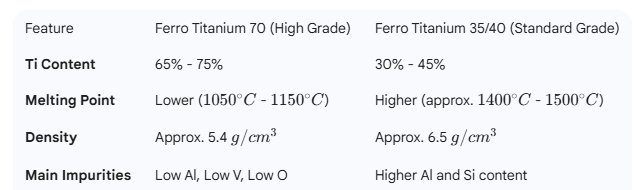
2. When to Choose FeTi 70 (High-Grade)
Ferro Titanium 70 is typically produced by melting titanium scrap with iron in induction furnaces.
Key Advantage: It has a lower melting point than the steel melt. This allows for rapid dissolution and high titanium recovery rates.
Best For: * Stainless Steel Production: Specifically for 300-series (like 321) to prevent intergranular corrosion.
Interstitial-Free (IF) Steels: Where ultra-low carbon and high purity are required.
Aerospace & High-Tech Alloys: Where strict control over trace elements (like Oxygen and Nitrogen) is critical.
3. When to Choose FeTi 35/40 (Low-Grade)
Ferro Titanium 35 or 40 is often produced via the aluminothermic reduction process.
Key Advantage: While it has a higher melting point, it is often more cost-effective for applications where high titanium concentration isn't the priority.
Best For:
General Deoxidation: Removing oxygen and nitrogen in carbon steels.
Grain Refinement: Improving the mechanical properties of construction steel.
Foundries: Used in ladle additions for specialized cast iron products.
4. Critical Factors for Overseas Buyers
When you buy Ferro Titanium in bulk, price is not the only factor. To ensure a stable supply chain, consider:
Particle Size (Sizing): Whether you need 10-50mm lumps for ladle addition or fine powder for cored wire, ensure your supplier can customize the sizing.
Impurity Control: For high-end steel, look for Low Oxygen Ferro Titanium to ensure the cleanliness of the steel.
Packaging: Quality FeTi suppliers provide moisture-proof packaging (big bags or steel drums) to prevent oxidation during sea freight.
Conclusion
The choice between FeTi 70 and FeTi 35 depends on your furnace type, the target steel grade, and your budget. FeTi 70 offers superior performance and purity for high-end alloys, while FeTi 35 remains a reliable workhorse for general steelmaking.
As a dedicated Ferro Titanium factory, we provide certified FeTi 70 and FeTi 35 with customized specifications to meet international standards.
Looking for a reliable Ferro Titanium price quote for your next shipment? Contact Our Technical Sales Team Today or Request a Free Sample for Lab Testing.